Before You Pay for a Nail Certification: What Unlicensed Nail Students in Florida Need to Know
Nail courses are advertised everywhere. A prospective student may see an instructor offering a one-day acrylic class, a weekend Gel-X certification, an online nail technician course, or private training that promises to help beginners start accepting clients immediately.
The instructor may be a talented nail artist. The class may include a professional kit. The student may even receive an impressive certificate with their name printed on it.
But if the student is not already licensed or registered, that certificate may have no value toward becoming a legal nail professional in Florida.
Before paying hundreds or thousands of dollars for a private nail class, students need to understand the difference between learning a technique, earning a private certificate, and qualifying for Florida Nail Specialist registration.
They are not the same thing.
Can You Become a Certified Nail Technician Without Going to Nail School?
An individual instructor can create a class and give participants a certificate stating that they completed it. However, the existence of a certificate does not mean it is recognized by the State of Florida.
Florida requires aspiring Nail Specialists to complete 180 hours of education through an eligible Florida nail program. Graduates must then submit the appropriate application, school documentation, HIV/AIDS course documentation, and state fees to the Florida Department of Business and Professional Regulation, commonly known as the DBPR.
According to the Florida DBPR Nail Specialist application requirements, applicants must provide a certificate of completion from an approved specialist training program.
A short class offered independently by a nail technician generally does not satisfy that requirement.
The instructor’s certificate may show that you attended that instructor’s class. It does not necessarily establish that you completed the education required to qualify for Florida registration.
A Nail License and a Nail Certificate Are Not the Same Thing
The terms “licensed,” “registered,” and “certified” are frequently used interchangeably in online advertising, but they do not mean the same thing.
Florida Nail Specialist registration
This is the professional credential issued through the Florida DBPR after an applicant completes the required education and application process.
School certificate of completion
This is documentation from an eligible school confirming that the student successfully completed the required Nail Specialist program. It is used as part of the state registration process.
Private class certificate
This normally shows that someone attended or completed a particular instructor’s course. It may be valuable as a record of advanced education, but it does not independently grant the legal authority to perform nail services professionally.
A private business can call almost any course a “certification class.” The word certification does not automatically mean that a government agency, professional licensing board, or recognized accrediting organization has approved it.
Students should always ask what the certificate legally qualifies them to do.
Warning Signs That a Nail Course May Be Misleading
Not every independent instructor is attempting to mislead students. Many professionals provide legitimate advanced education and clearly explain who is eligible to attend.
Problems arise when a course is advertised to unlicensed beginners without explaining that it does not lead to Florida registration.
Watch for these warning signs.
The instructor says you do not need a license
Be cautious if someone tells you Florida does not require registration to provide manicures, pedicures, acrylic nails, Gel-X, or other regulated nail services to paying clients.
The course promises to make you a nail technician in one day
A one-day class may introduce a product or technique. It cannot provide the equivalent of a complete 180-hour Florida Nail Specialist education.
The instructor says the certificate allows you to take clients
Ask the instructor to identify the specific Florida registration for which the course qualifies you. Verify the answer independently through the DBPR before paying.
Do not rely on a verbal promise.
The instructor avoids questions about school licensing
A personal Nail Specialist registration allows someone to perform nail services within the permitted scope. It does not automatically authorize that person to operate a school or provide initial licensing education to unlicensed students.
Ask for the school’s full legal name and license information.
The instructor advertises a shortcut around nail school
Statements such as “skip beauty school,” “no license needed,” or “start making money tomorrow” should be treated as serious warning signs.
There is no private certificate that allows an instructor to waive Florida’s education requirements.
The instructor focuses only on the finished nail design
Beautiful photos do not prove that a course includes sanitation, infection control, nail anatomy, product chemistry, safe removal, Florida law, or client protection.
A person can be a talented nail artist without being authorized or prepared to provide initial professional education to unlicensed beginners.
The course details are not provided in writing
Before paying, the student should receive clear information about:
- Course length
- Student eligibility
- Instructor qualifications
- Techniques covered
- Hands-on practice
- Kit contents
- Tuition and additional fees
- Refund policies
- Certificate limitations
- Whether the course leads to Florida registration
- What the student may legally do after completing it
Vague promises are not a substitute for written information.
When Is A Private Nail Class A Scam?
The word “scam” should not be applied to every private class. A licensed Nail Specialist may legitimately take an advanced course to improve a particular skill. A beginner might also knowingly take a recreational class for personal interest.
The concern is what the course is represented to be.
If an instructor knows a student is unlicensed but implies that a short private course will qualify the student to work professionally, the student is being misled.
It is especially concerning when an instructor:
- Promises the student can legally accept paying clients
- Represents a private certificate as equivalent to state registration
- Claims the class replaces Florida’s required education
- Conceals the fact that the student must still attend an eligible school
- Uses words such as “licensed,” “accredited,” or “state certified” inaccurately
- Collects payment after learning the student’s goal is initial licensure
- Encourages the student to begin providing services illegally
- Refuses to explain the limitations of the certificate
The instructor should understand the difference between an advanced training certificate and an initial licensing program. If that difference is deliberately concealed to make a sale, the student may reasonably feel that they have been scammed.
Language Barriers Can Make Students More Vulnerable
We frequently meet students who previously paid for private nail classes because they genuinely believed the certificate would allow them to work professionally in Florida. This appears to happen more often when English is not the student’s primary language.
Some private courses are advertised and taught entirely in Spanish or Vietnamese. Providing education in a student’s preferred language is not the problem. Bilingual education can make learning more accessible and effective.
The concern arises when an instructor uses a student’s limited familiarity with English or Florida licensing laws to sell a certificate that does not qualify the student for professional registration.
Florida’s statutes, licensing applications, administrative rules, and official government explanations can be difficult for anyone to interpret. They may be especially confusing for someone who:
- Is new to Florida or the United States
- Received professional education in another country
- Comes from a country with different licensing requirements
- Speaks English as a second language
- Has difficulty reading legal or government terminology
- Assumes that “certified” and “licensed” mean the same thing
- Trusts an instructor who speaks their primary language
- Does not know how to verify a school independently
A student may hear “certification class” translated into their language and reasonably believe that the certificate is recognized by Florida. The student may not realize that completing a private class and qualifying for Nail Specialist registration are entirely different things.
Trust should never be used to avoid full disclosure
Students often feel more comfortable learning from someone who speaks their primary language and understands their culture. That relationship can create an important sense of trust.
A responsible instructor will honor that trust by clearly explaining:
- Whether the student must already be licensed
- Whether the class is initial or advanced education
- Whether the instructor operates through an authorized school
- Whether the course satisfies any part of Florida’s 180-hour requirement
- Whether the certificate can be used to apply for state registration
- What the student may legally do after completing the class
This information should be provided in the same language used to advertise and sell the course.
It is not enough to promote a class in Spanish or Vietnamese and then place an unclear English disclaimer in a contract or at the bottom of a social media post. If a class is marketed in a particular language, its licensing limitations, eligibility requirements, refund policies, and certificate restrictions should be explained clearly in that language as well.
Misleading translations can create false expectations
Certain phrases can sound official even when they have no government recognition. Students should be cautious when they see translated versions of terms such as:
- Certified nail technician
- Professional nail certification
- Licensed nail course
- Accredited nail artist
- International nail certification
- State-recognized certificate
- Work-ready certification
- No license required
The important question is not what the instructor calls the certificate. The important question is whether completing the program makes the student eligible to apply for Florida Nail Specialist registration.
Students should ask the instructor to answer this question directly and in writing:
“After completing this course, will I have satisfied Florida’s 180-hour education requirement and be eligible to apply for Nail Specialist registration through the DBPR?”
If the answer is no, the course should not be presented as a substitute for nail school.
Previous education from another country may not transfer automatically
Some students previously worked in the beauty industry in another country and understandably assume that a private Florida certificate will allow them to continue working here.
Florida has specific requirements for education, registration, and endorsement. Training or experience completed outside the United States does not automatically qualify someone for Florida registration.
The DBPR states that out-of-country applicants do not qualify through the same endorsement process available to certain applicants holding active licenses from other U.S. states.
Students with international education should obtain accurate guidance before paying for additional training. An instructor should never promise that a short private course can convert international experience into a Florida registration unless that pathway has been verified with the appropriate state agency.
Students deserve information they can fully understand
A language barrier should never be treated as an opportunity to make a sale.
Students deserve to understand exactly what they are purchasing before paying a deposit or signing an agreement. If an instructor knows an unlicensed student does not understand Florida’s requirements and allows that student to believe a private certificate grants the right to work, the student’s trust and language barrier are being exploited.
Before paying, students should request:
- A written explanation in their preferred language
- The legal name and license number of the school
- Confirmation that the program includes Florida’s required 180 hours
- A complete list of tuition, fees, and supplies
- The cancellation and refund policy
- An explanation of the certificate’s legal limitations
- Confirmation of what is required to apply through the DBPR
Students may also want a trusted bilingual family member, advocate, or qualified school representative to review the information with them.
The Student May End Up Paying Twice
One of the most frustrating outcomes occurs when an unlicensed beginner pays for several private classes and later discovers that none of those hours count toward Florida registration.
The student may have purchased:
- A beginner acrylic course
- A Gel-X certification
- An electric-file class
- A pedicure workshop
- An online nail technician program
- Multiple product kits
- Private coaching sessions
After spending that money, the student must still enroll in and complete an eligible 180-hour Nail Specialist program.
The student has effectively paid twice: first for certificates that did not lead to registration and then for the education Florida actually requires.
Students should verify a program before paying a nonrefundable deposit.
Incomplete Nail Training Can Be Dangerous
The risk is not limited to wasted money.
A short technique class may teach students how to create a finished set without providing the foundational knowledge needed to work safely with the public.
A beginner may learn which product to apply without understanding:
- Nail structure and growth
- Product chemistry
- Allergic reactions and overexposure
- Contraindications
- Infection control
- Cross-contamination
- Cleaning and disinfection
- Safe electric-file use
- Correct product removal
- Natural nail protection
- When a service should be refused
- Florida salon requirements
- The legal scope of a Nail Specialist
The work may look attractive in a photograph while still being performed incorrectly or unsafely.

Incorrect electric-file training can damage the natural nail
Electric files can improve efficiency when used correctly. When used incorrectly, they can cause pain and damage.
An improperly trained student may:
- Use excessive pressure
- Select the wrong bit
- Operate at an inappropriate speed
- Remain in one area too long
- File through the enhancement
- Thin or burn the natural nail
- Damage the surrounding skin
- Use improperly disinfected bits
Watching an instructor perform a fast acrylic removal does not mean a beginner is prepared to reproduce it safely.
Students need time to practice, receive corrections, develop control, and understand why a particular technique is used.
Poor sanitation education can put clients at risk
Nail professionals serve multiple clients using shared surfaces, workspaces, equipment, and implements. Without proper sanitation education, contamination can move from one client to another.
Common problems may include:
- Reusing disposable items
- Failing to clean tools before disinfecting them
- Using an improper disinfectant
- Mixing disinfectant incorrectly
- Ignoring the required contact time
- Placing clean and contaminated implements together
- Reusing porous items
- Contaminating clean products
- Failing to clean electric-file bits correctly
- Performing a service that should be refused
Sanitation is not an optional addition to nail training. It is a core professional responsibility.
Nail professionals must know when not to perform a service
Nail Specialists are not medical professionals and should not diagnose or treat medical conditions. They do need enough education to recognize when a service may be unsafe.
A beginner who has only learned application steps may cover a concerning nail with product instead of recognizing that the service should not proceed.
Knowing when not to perform a service is just as important as knowing how to perform one.
Social Media Popularity Is Not School Authorization
A large following, beautiful portfolio, viral video, or successful salon does not establish that someone is authorized to provide initial licensing education.
When evaluating an instructor, separate these questions:
- Is this person a talented nail artist?
- Is this person properly registered to perform nail services?
- Is this person qualified to teach the specific technique?
- Is the class offered through a legally authorized school?
- Will the program satisfy Florida’s initial registration requirements?
The answer to one question does not automatically answer the others.
A person can be an excellent nail artist without being able to provide a legally qualifying Nail Specialist program for unlicensed beginners.
When Are Advanced Nail Classes Worth Taking?
Advanced education can be an excellent investment after someone completes foundational training and obtains the appropriate professional credential.
A registered Nail Specialist may choose advanced education in:
- Gel-X
- Acrylic structure
- Builder gel
- Nail art
- Electric filing
- Advanced pedicures
- Product-specific systems
- Photography and social media
- Salon business development
- Speed and efficiency
- Client retention
At this stage, the professional already has foundational education in sanitation, safety, nail anatomy, and legal responsibilities. The advanced class builds upon that knowledge.
A reputable instructor should clearly identify whether a course is:
- A recreational class
- A product demonstration
- Advanced education for licensed professionals
- Continuing education
- Part of an eligible initial licensing program
Students should never be left to assume.
Where are legitimate advanced nail courses usually offered?
Legitimate advanced nail education is commonly offered through:
- Licensed beauty schools
- Recognized beauty-industry trade shows
- Professional product manufacturers
- Authorized beauty distributors
- Established professional academies
- Experienced educators who limit enrollment to appropriately licensed or registered professionals
Licensed schools and professional beauty trade shows are often among the safest places to look for advanced education. These providers typically identify prerequisites, course length, techniques covered, kit contents, instructor qualifications, and what the completion certificate represents.
Professional beauty trade shows may offer demonstrations, hands-on workshops, product education, and advanced technique classes specifically designed for people already working in the industry. Licensed schools can provide advanced courses in an established educational environment with clear enrollment standards and professional oversight.
However, the location or name of an event alone does not guarantee that every course is appropriate for every student. Before enrolling, confirm whether the course is intended for licensed professionals, students currently enrolled in an eligible program, or members of the general public.
A legitimate advanced educator should:
- Clearly state any license or registration prerequisite
- Verify professional credentials when required
- Explain that the course does not replace initial licensing education
- Provide a detailed course description
- Identify the products and techniques being taught
- Explain what is included in the tuition and kit
- Use appropriate sanitation and safety procedures
- Teach within Florida’s permitted professional scope
- Accurately describe the meaning of the certificate
Be cautious when an instructor advertises an “advanced certification” to complete beginners without asking whether they are licensed or currently enrolled in nail school.
If a course teaches professional services but the provider appears unconcerned about whether students are legally eligible to perform those services, that is an important warning sign.
A reputable advanced course helps an existing or developing professional expand upon legitimate foundational education. It should never be marketed as a shortcut around the education and registration required to enter the profession.
The Correct Order for Building a Nail Career
For someone beginning without a professional registration, the appropriate progression is:
1. Attend an eligible Nail Specialist program
Complete the 180 hours required by Florida through a school or program authorized to provide the education.
2. Complete the school’s requirements
Finish the required theory, practical assignments, sanitation education, attendance hours, and evaluations.
3. Apply for Florida Nail Specialist registration
Submit the required application and supporting documents to the DBPR.
4. Begin working legally
Work within the Nail Specialist scope and comply with applicable salon, sanitation, and business requirements.
5. Invest in advanced education
Once properly registered, choose reputable schools and educators that can help you develop specialized techniques.
Advanced education should build upon legitimate foundational training—not attempt to replace it.
Questions to Ask Before Paying for a Nail Course
Ask the instructor these questions in writing:
- Is this an initial licensing program or an advanced class?
- Is the class intended only for licensed professionals?
- If I am unlicensed, what will this certificate legally allow me to do?
- Does the course satisfy Florida’s 180-hour requirement?
- Is the training provided through an authorized school?
- What is the school’s full legal name and license number?
- Will I be eligible to apply for Florida Nail Specialist registration?
- What techniques and safety subjects are included?
- How much supervised practical experience will I receive?
- What products and supplies are included?
- What is the refund policy?
- Are there additional fees?
- Can I verify these claims through the Florida DBPR?
Save the instructor’s answers, advertisements, receipts, enrollment agreement, and refund policy.
If the instructor will not answer basic licensing questions clearly, do not pay until you have verified the course independently.
How to Verify a Florida Nail Program
Do not verify a program only by asking the person selling it.
Students can review the current requirements on the Florida DBPR Nail Specialist Registration page.
Florida’s specialty registration qualifications are also addressed in Section 477.0201 of the Florida Statutes.
When contacting a school, ask its admissions team to explain:
- How the school is licensed
- How the program satisfies Florida’s 180-hour requirement
- What documentation graduates receive
- How students apply for Florida registration
A reputable school should welcome these questions.
Frequently Asked Questions
Can an independent Nail Specialist teach a class?
A professional may provide instruction within applicable laws, but that does not mean the course qualifies an unlicensed student for Florida registration. The instructor must accurately explain what the course and certificate do—and do not—authorize.
Can I take an acrylic or Gel-X class before nail school?
You may be able to attend a recreational or introductory class, depending on the instructor’s policies. However, it generally will not replace the required Nail Specialist education unless it is provided through an eligible school as part of its program.
If your goal is to work professionally, it may make more financial sense to complete your foundational education first.
Can I accept clients after receiving a private certificate?
A private certificate alone does not grant the legal authority associated with Florida Nail Specialist registration. Do not begin accepting paying clients based solely on an independent instructor’s certificate.
Is an online nail technician certificate valid in Florida?
An online certificate is not automatically valid for initial Florida registration. Verify whether the provider is an eligible school, whether the program satisfies Florida’s required hours, and how practical skills are taught and evaluated.
What if the instructor is licensed?
The instructor’s personal credential allows that person to perform services within their professional scope. It does not automatically transform the instructor’s private business into an authorized school or make the certificates issued by that person eligible for state registration.
What if I was trained in another country?
International education and experience do not automatically qualify someone for Florida Nail Specialist registration. Contact the Florida DBPR or an eligible Florida school for guidance before paying for a private course that promises to convert your previous training.
Where should I look for advanced nail education?
Licensed beauty schools, established professional academies, beauty-industry trade shows, product manufacturers, and authorized distributors are good places to begin. Always confirm prerequisites and verify that the course is designed for someone with your current license or registration status.
Nail Specialist Training at IMAGE
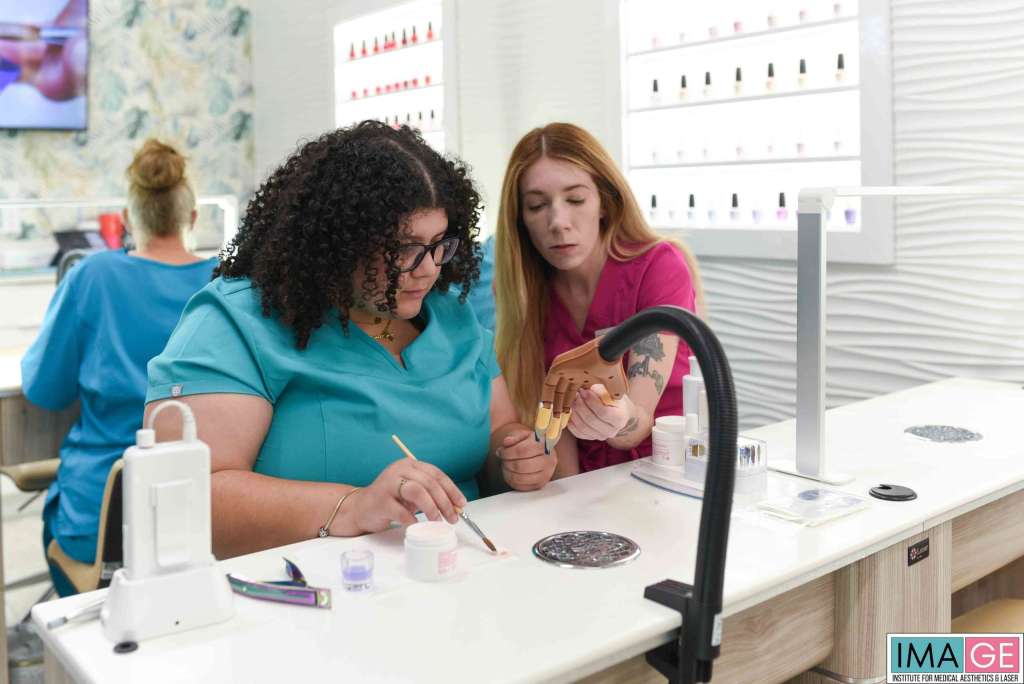
The Institute for Medical Aesthetics & Laser offers a 180-hour Nail Specialist program designed for students who want to qualify for Florida registration and build a professional nail career.
The approximately six-week hybrid program combines structured homestudy with scheduled in-person education and supervised practical training.
IMAGE students receive education in areas such as:
- Manicures and pedicures
- Natural nail care
- Gel polish
- Acrylic enhancements
- Gel systems
- Gel-X
- Nail art
- Electric-file fundamentals
- Product application and removal
- Nail structure and disorders
- Sanitation and infection control
- Client consultation
- Florida laws and professional standards
- Business and career development
Students train with professional products and systems, including OPI, Young Nails, and Gel-X techniques. They develop practical skills with instructor guidance instead of relying exclusively on videos or demonstrations.
Spanish materials and bilingual instruction are available for designated classes. Our goal is not simply to translate nail techniques. We want students to understand Florida’s licensing pathway, what their education qualifies them to do, and how to begin working legally and safely.
The Institute for Medical Aesthetics & Laser is licensed by the Florida Commission for Independent Education, License #13176.
IMAGE is located at Merchants Crossing in North Fort Myers and serves students from Fort Myers, Cape Coral, Lehigh Acres, Estero, Bonita Springs, Naples, Punta Gorda, and communities throughout Southwest Florida.
Protect Your Education, Money, and Future Career
There is nothing wrong with investing in education. The problem occurs when students pay for a certificate that has been represented as something it is not.
Before enrolling, determine whether you are purchasing:
- A recreational learning experience
- An advanced class for licensed professionals
- A product-specific workshop
- Or an eligible program leading toward Florida Nail Specialist registration
If your goal is to become a professional nail technician, begin with legitimate foundational education. Do not allow promises of a shortcut to cost you more money, delay your registration, leave gaps in your training, or encourage you to work illegally.
Once you are properly educated and registered, legitimate advanced classes offered through licensed schools, professional trade shows, established academies, manufacturers, and qualified educators can become valuable tools for expanding your skills and building your career.
If you are considering a nail career in Southwest Florida, schedule a tour of the Institute for Medical Aesthetics & Laser. Our admissions team can explain Florida’s education requirements, show you our professional nail training environment, and help you understand the difference between initial licensing education and advanced professional training.