How to Become a Nail Technician in Florida
If you love nail art, enjoy working with people, and want a career that allows you to be creative, becoming a nail technician may be the right path for you.
Nail professionals can work in salons, spas, resorts, and specialty nail studios. With experience, some build independent businesses, rent salon suites, or develop loyal clienteles of their own.
Before you can legally provide professional nail services in Florida, however, you must complete the education and registration requirements established by the state.
This guide explains how to become a nail technician in Florida, how many training hours you need, whether Florida requires a state board examination, what you should learn in nail school, what is included in the IMAGE student kit, and how to avoid paying for certificates that do not qualify you to work legally.
What Is a Nail Technician Called in Florida?
People commonly use the terms “nail technician,” “nail tech,” “manicurist,” and “nail artist.” In Florida’s licensing system, the official professional credential is generally called Nail Specialist registration.
A registered Florida Nail Specialist may provide permitted services involving the beautification of the hands, feet, and nails, including manicures, pedicures, and nail extension services.
Clients and employers may call you a nail technician, but the professional registration you apply for through the Florida Department of Business and Professional Regulation, commonly known as the DBPR, is Nail Specialist registration.
Do You Need a License to Do Nails in Florida?
Yes. You must hold the appropriate Florida professional registration before providing regulated nail services to the public for compensation.
Completing a short private class, receiving a certificate from an independent nail artist, or learning how to do nails through online videos does not qualify someone for Florida Nail Specialist registration.
A certificate is useful for initial registration only when it documents completion of the required program through a school or program legally authorized to provide that education.
This is one of the most important distinctions future students need to understand:
Learning how to perform a nail service is not the same as completing the education required to work legally in Florida.
Private workshops may be valuable as advanced education for professionals who are already properly licensed or registered. They do not replace an eligible Nail Specialist program for an unlicensed beginner.
Be Careful With Private Nail “Certification” Classes
If you are not already licensed or registered, a private nail class generally cannot replace Florida’s required 180-hour Nail Specialist program.
A certificate from an independent nail technician, salon owner, social media educator, or online course does not automatically qualify you to apply for Florida registration or begin accepting paying clients.
Private and advanced classes can be valuable for properly licensed professionals who want to expand their skills. Unlicensed beginners, however, should verify that a program is offered through a legally authorized school before paying.
Otherwise, they may spend money on a certificate with no licensing value and receive incomplete education that leaves out sanitation, safety, Florida law, and essential nail-care fundamentals.
Students should be especially cautious when a course:
- Promises to make beginners “certified” in one day
- Claims students can immediately begin accepting clients
- Does not ask whether students hold a professional registration
- Avoids explaining whether the provider operates through a licensed school
- Claims the certificate replaces Florida’s required education
- Uses terms such as “accredited” or “state certified” without verification
- Provides no written explanation of what the certificate legally allows
We frequently meet students who paid for private classes because they genuinely believed the certificate would qualify them to work. This can be especially confusing for students whose primary language is not English and who may have difficulty interpreting Florida’s licensing terminology.
If a course is advertised in Spanish, Vietnamese, or another language, its licensing limitations should also be explained clearly in that language.
Before purchasing a private course, read our detailed guide: Before You Pay for a Nail Certification: What Unlicensed Students in Florida Need to Know.
How Many Hours Are Required to Become a Nail Technician in Florida?
Florida requires aspiring Nail Specialists to complete 180 hours of education in an eligible Florida nail program.
Under Florida law, the training must be completed through an authorized school or specialty program. The curriculum must address professional skills as well as sanitation and safety.
The state’s requirements are intended to ensure graduates understand more than how to create an attractive set of nails. Nail professionals work directly with clients’ hands, feet, skin, and natural nails. They also use implements, electric files, chemicals, adhesives, enhancement products, and disinfectants that must be handled correctly.
Proper Nail Specialist education helps students learn how to:
- Clean and disinfect tools and work areas
- Prevent infection and cross-contamination
- Recognize when a service should not be performed
- Use professional products correctly
- Protect the client’s natural nails
- Perform services safely and consistently
- Follow Florida laws and salon requirements
- Communicate professionally with clients
- Build responsible business practices
According to the Florida DBPR, applicants must complete 180 school hours and submit a certificate of completion from an approved specialist training program. Students can review the current requirements on the Florida DBPR Nail Specialist Registration page.
How to Become a Nail Technician in Florida
The general process includes the following steps.
1. Meet Florida’s age or education requirement
A Nail Specialist applicant must be at least 16 years old or have received a high school diploma.
A college degree is not required. Individual schools may establish additional admissions requirements, so confirm the school’s policies before enrolling.
2. Enroll in an eligible Florida Nail Specialist program
Choose a school legally authorized to provide the education required for Florida registration.
Do not assume that someone offering nail classes operates a licensed school. Before paying tuition or a deposit, ask:
- Is this a legally authorized school?
- What is the school’s license number?
- Does the program provide all 180 required hours?
- Will I receive the documents needed to apply through the DBPR?
- Is this an initial licensing program or an advanced workshop?
- How much hands-on training will I receive?
- What products, equipment, and techniques will I learn?
- What is included in the student kit?
- What is the kit’s retail value and student cost?
- Are there additional fees?
- What are the schedule and attendance requirements?
- How long does the program take?
- Is information available in my primary language?
A reputable school should answer these questions clearly and provide important program information in writing.
3. Complete all 180 required hours
Students must complete the curriculum and satisfy their school’s attendance, academic, practical, and graduation requirements.
A comprehensive program includes theory and practical education.
Theory teaches the reasons behind professional procedures, including sanitation, nail structure, product chemistry, nail disorders, safety, client consultation, and Florida law.
Practical education allows students to observe demonstrations, handle professional products, develop techniques, receive corrections, and repeat services under instructor supervision.
4. Complete the required HIV/AIDS education
Florida requires an initial board-approved HIV/AIDS course of at least four hours. According to the DBPR, the course must have been completed within the two years before the registration application is submitted.
Your school should explain how this requirement is incorporated and what documentation will be provided after graduation.
5. Graduate and receive your school documents
After successfully completing the program, students receive the documents needed for the Florida application.
These generally include a certificate of completion and the required eligibility or school certification documentation. Keep copies of all graduation and application records.
6. Apply for Florida Nail Specialist registration
Graduates apply through the Florida Department of Business and Professional Regulation.
The application requires supporting documents and a state fee. Because forms and fees can change, applicants should always use the current checklist published by the DBPR rather than an old form or unofficial website.
7. Begin working within Florida’s legal requirements
Florida law provides a limited pathway for an applicant to practice while registration is pending after the required application, proof of education, and fees have been submitted. The applicant must work under the supervision required by law in a properly licensed specialty or cosmetology salon.
Confirm that every condition has been satisfied before performing paid services. The applicable qualifications are described in Section 477.0201 of the Florida Statutes.
Do Nail Technicians Take a State Board Exam in Florida?
Florida does not currently require Nail Specialist applicants to take the Florida cosmetology examination.
Students must still successfully complete their school’s curriculum, required hours, practical assignments, and final evaluations. Graduating is not automatic simply because Florida does not require a separate state examination.
A strong program should verify that students understand sanitation, safety, professional procedures, and the practical skills needed to begin working with clients.
How Long Does Nail Technician School Take in Florida?
Program length depends on the school’s schedule and the number of hours completed each week.
At the Institute for Medical Aesthetics & Laser, the Nail Specialist program is designed to be completed in approximately six weeks. Students complete scheduled in-person education and structured homestudy.
IMAGE’s hybrid format includes:
- 180 total program hours
- Approximately six weeks of education
- 12 hours of scheduled in-person training each week
- 18 hours of structured homestudy each week
- Hands-on practice in a professional nail training environment
- Day and evening schedules based on availability
This format gives students the flexibility to complete part of their theory education at home while preserving the in-person instruction needed to develop practical nail skills.
“Hybrid” should not mean students are left to teach themselves how to perform professional services. Nail students need demonstrations, supervised practice, correction, repetition, and feedback from qualified instructors.
Can You Complete Nail Technician School Entirely Online?
Be cautious of any program claiming that an unlicensed beginner can become a Florida Nail Specialist through a quick online certificate alone.
Online theory and structured homestudy can be valuable parts of a properly organized hybrid program. However, nail services are hands-on skills. Students need opportunities to:
- Observe professional demonstrations
- Handle products and equipment
- Practice application and removal
- Develop electric-file control
- Receive instructor feedback
- Correct unsafe habits
- Perform services in an appropriate learning environment
- Demonstrate practical competency
An online class from an individual nail artist may teach a useful technique, but it does not automatically satisfy Florida’s 180-hour requirement.
Before enrolling in an online or hybrid program, verify:
- The identity and licensing status of the school
- Whether the program qualifies graduates to apply in Florida
- How practical skills are taught and evaluated
- Where in-person education takes place
- Who supervises practical services
- What graduation documentation is provided
What Do You Learn in Nail Technician School?
A Florida Nail Specialist program should prepare students for much more than polishing nails.
Natural nail care
Students may learn:
- Manicures and pedicures
- Nail shaping
- Cuticle care
- Polish application
- Gel polish application and removal
- Client consultation
- Natural nail protection
- Service preparation and finishing
Artificial nail services
Depending on the school’s curriculum, students may receive education in:
- Nail tips and extensions
- Acrylic enhancements
- Gel enhancements
- Builder gel
- Overlays
- Fills and maintenance
- Nail repair
- Product removal
- Gel-X or soft-gel extension systems
IMAGE students train with professional products and systems, including Young Nails and Gel-X techniques, so they gain experience with services commonly requested in today’s industry.
Nail art and design
Students may practice:
- Basic nail art
- Color application
- French designs
- Decorative techniques
- Seasonal designs
- Current salon trends
- Photography and presentation of finished work
Trends change throughout a nail technician’s career. A strong technical foundation helps graduates continue learning new designs and product systems after registration.
Sanitation and infection control
Students should understand:
- The difference between cleaning and disinfecting
- How to prevent cross-contamination
- Proper handling of reusable implements
- Which items must be discarded after use
- Safe workstation preparation
- Appropriate disinfectant use
- When a service should be refused
- Salon sanitation requirements
- Personal protective practices
Nail structure, diseases, and disorders
Nail Specialists are not medical professionals and do not diagnose or treat medical conditions. They do need to recognize when a nail or skin condition may make a service inappropriate or unsafe.
Students learn the difference between a cosmetic concern that may be serviced and a condition that should be referred to an appropriate healthcare professional.
Electric-file safety
An electric file can be a valuable professional tool, but incorrect use can damage the natural nail or surrounding skin.
Students should learn about:
- Bit selection
- Speed and pressure
- Hand positioning
- Product removal
- Enhancement refinement
- Cleaning and disinfection
- Protecting the natural nail
- When an electric file should not be used
Professional and business skills
Technical ability is only one part of a successful nail career. Professionals also need strong client service and business habits.
Students may learn about:
- Client consultations
- Rebooking and retention
- Professional communication
- Time management
- Service pricing
- Social media and portfolio building
- Personal branding
- Salon professionalism
- Florida laws and rules
- Career planning
What Is Included in the IMAGE Nail Specialist Student Kit?
The quality of a student kit matters. Nail students need more than a few sample products—they need professional tools and complete product systems that allow them to practice throughout school and prepare for salon services.
Student kits are commonly marked up by beauty schools, increasing what students pay for required products and equipment. IMAGE does not mark up its student kits. Instead, we pass our discounted pricing directly to our students.
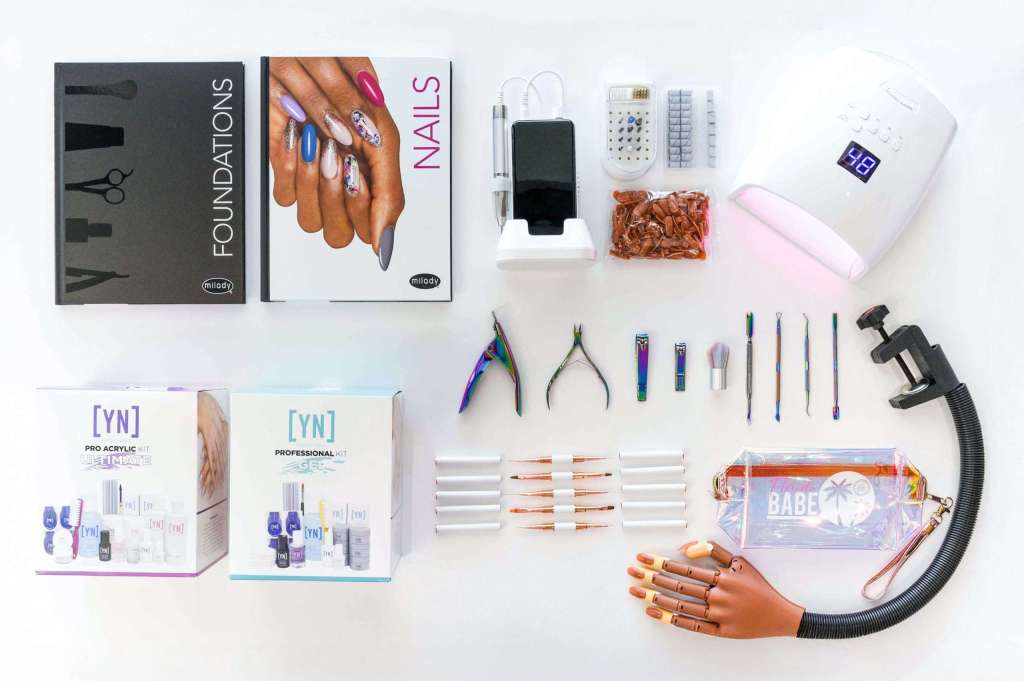
The IMAGE Nail Specialist kit has an approximate retail value of $1,500, but students pay only $1,000.
The kit includes professional acrylic and gel systems from Young Nails, along with an e-file, LED lamp, practice hand, reusable implements, brushes, essential supplies, and Milady textbooks.
This is not a small collection of sample-sized products or inexpensive tools selected only to satisfy a basic supply requirement. It is a career-focused kit designed to support students throughout the Nail Specialist program and provide products and equipment they can continue using after graduation.
Professional e-file kit
Students receive:
- High-performance electric nail file
- Full assortment of e-file bits
- Bit organizer
The e-file is used during supervised training to help students develop skills in nail preparation, shaping, enhancement refinement, maintenance, and product removal.
Students also learn the importance of correct speed, pressure, bit selection, hand positioning, and sanitation.
Stainless steel implements and professional tools
The kit includes:
- Cuticle pushers
- Cuticle nippers
- Nail clippers
- Nail art brushes
- Dust brush
- Professional LED nail lamp
- Practice hand
- Disposable nail files
Reusable stainless steel implements allow students to practice appropriate cleaning and disinfection procedures. The LED lamp is used for curing compatible gel products, while the practice hand gives students additional opportunities to improve shaping, application, filing, and nail art.
Young Nails Pro Gel Kit
The professional gel system includes:
- Base gel
- Builder gel
- Flex gel
- Pink gel
- White gel
- Finish gel
- Nail forms
- Assorted nail tips
- Protein Bond
- Nail glue
- Finesse Pro Gel Sculptor brush
- Manicure brush
The gel kit allows students to practice professional gel services using a complete product system rather than a few individual samples.
Students learn how the products function, how to prepare the nail, how to control and apply gel, and how to build balanced enhancements while protecting the natural nail.
Young Nails Pro Acrylic Ultimate Kit
The professional acrylic system includes:
- Clear acrylic powder
- White acrylic powder
- Pink acrylic powder
- Blush acrylic powder
- Monomer
- Protein Bond primer
- Swipe nail cleanser
- Rose cuticle oil
- Top coat or finish gel
- Nail forms
- Assorted nail tips
- Brush-on glue
- Dappen dish and dropper
- Acrylic brush
- Files and buffers
Students use this system to develop acrylic skills such as liquid-to-powder ratio, bead control, tip application, form placement, sculpting, shaping, filing, finishing, fills, maintenance, and safe removal.
Milady textbooks
The kit includes Milady textbooks supporting the theory covered throughout the program.
Students study subjects such as:
- Nail anatomy and growth
- Nail conditions and disorders
- Infection control
- Cleaning and disinfection
- Product chemistry
- Client safety
- Professional procedures
- Florida laws and standards
- Career and business fundamentals
The textbooks help students understand why services are performed in a particular way—not simply how to copy the application steps.
Why the quality of a student kit matters
When comparing Florida nail schools, do not ask only whether a kit is included. Ask exactly what is inside it.
A basic kit may contain a small number of sample products while requiring students to purchase their own e-file, LED lamp, professional brushes, practice hand, enhancement systems, or textbooks separately.
Those purchases can significantly change the actual cost of attending a program.
Prospective students should ask:
- What is the kit’s retail value?
- Does the school add a markup?
- Are the products professional brands?
- Is a complete acrylic system included?
- Is a complete gel system included?
- Are an e-file, bits, and organizer included?
- Is an LED lamp included?
- Is a practice hand included?
- Are professional brushes included?
- Are reusable stainless steel implements included?
- Are textbooks included?
- Do students keep their equipment?
IMAGE students receive a professional kit with an approximate retail value of $1,500 for a discounted student cost of $1,000. We do not add a markup to required student kits.
Student kits are provided as-is for educational use. No warranty, replacement, or exchange is available. Specific products, colors, packaging, and individual items are subject to change based on availability.
What Is the Difference Between a Nail Specialist and a Full Specialist?
A Nail Specialist program focuses on manicures, pedicures, nail enhancements, and other permitted nail services.
A Florida Full Specialist program combines nail training with facial specialty education. Florida requires substantially more education for Full Specialist registration than it requires for Nail Specialist registration.
A Nail Specialist program may be the right choice if you want to concentrate on nail services and prefer a shorter, focused route into the beauty industry.
A Full Specialist program may be a better fit if you want broader education that includes both nail and skincare services.
Neither choice is automatically better. The right program depends on the services you want to perform and the career you hope to build.
Where Can a Florida Nail Technician Work?
Registered Nail Specialists may pursue opportunities in:
- Nail salons
- Full-service salons
- Day spas
- Resorts and hotels
- Beauty bars
- Specialty nail studios
- Salon suites
- Independent businesses operating from appropriately licensed locations
Some graduates begin as employees or commission-based technicians to build speed, confidence, and professional experience. Others rent a station or salon suite after developing a clientele. Some eventually open their own salons.
Salon ownership involves additional licensing, zoning, insurance, sanitation, tax, lease, and business requirements. A personal Nail Specialist registration does not by itself authorize someone to operate an unlicensed salon.
Can a Nail Technician Work From Home in Florida?
A Nail Specialist registration does not automatically allow someone to provide services from any residence.
The location where professional nail services are performed must comply with applicable salon licensing requirements as well as local zoning, sanitation, building, and business regulations.
Before accepting clients from a home-based location, verify the requirements with the DBPR and appropriate local authorities.
How Much Can a Nail Technician Earn in Florida?
There is no single guaranteed salary for entering the nail industry. Income varies based on factors such as:
- Geographic location
- Employment arrangement
- Services offered
- Technical skill
- Speed and efficiency
- Client retention
- Pricing and tips
- Retail sales
- Specialty services
- Schedule availability
- Marketing and social media
- Whether the technician is an employee, renter, or business owner
Technicians who provide consistent services, create a professional client experience, photograph their work, rebook clients, and continue developing advanced skills may have more opportunities to increase their income.
Be cautious of any school or instructor promising guaranteed earnings. Professional education can prepare you for the industry, but building a clientele requires continued effort after graduation.
When Should You Take Advanced Nail Courses?
Advanced courses are most valuable after a student has completed foundational education and obtained the appropriate professional registration.
A registered Nail Specialist may pursue advanced education in:
- Gel-X
- Acrylic structure
- Builder gel
- Nail art
- Electric filing
- Product-specific systems
- Advanced pedicure techniques
- Photography and marketing
- Speed and efficiency
- Client retention
- Business development
Legitimate advanced education is commonly offered through licensed beauty schools, recognized beauty-industry trade shows, professional product manufacturers, authorized distributors, and established professional academies.
Reputable advanced educators should clearly state license prerequisites, course content, kit inclusions, instructor qualifications, and what the certificate represents.
An advanced certificate documents additional education. It does not create the underlying authority to work as a Nail Specialist.
The appropriate order is:
- Complete an eligible 180-hour Florida Nail Specialist program.
- Apply for Florida Nail Specialist registration.
- Begin working within the permitted professional scope.
- Pursue reputable advanced education to expand your skills.
How to Choose a Nail Technician School
The fastest or least expensive option is not always the best value. Your education becomes the foundation for every client you will eventually serve.
Is the school properly licensed?
Verify the school’s status and confirm its program can provide the documentation required for Florida registration.
The Institute for Medical Aesthetics & Laser is licensed by the Florida Commission for Independent Education, License #13176.
Is the program truly hands-on?
Ask how much supervised practice students receive, which services they perform, and whether they train with professional products and equipment.
Are the program details provided in writing?
A reputable school should clearly explain:
- Total program hours
- Program length
- Class schedule
- Tuition and fees
- Kit cost and contents
- Attendance requirements
- Graduation standards
- Techniques covered
- Registration process
- Refund and cancellation policies
Can you tour the school?
A tour allows you to see the learning environment, visit the nail training area, ask questions, and determine whether the program feels like the right fit.
Can you see student work and reviews?
Photos, videos, graduate experiences, and current student reviews can help you understand the school’s learning environment.
Look for evidence of real student education rather than relying only on polished advertising.
Does the program teach modern services?
Ask whether the program includes gel polish, acrylics, builder gel, gel enhancement systems, pedicures, electric-file fundamentals, nail art, and soft-gel extensions such as Gel-X.
Does the school offer language support?
If English is not your primary language, ask whether the school offers translated materials, bilingual instruction, or assistance understanding Florida’s registration process.
Does the program prepare students for a career?
Look for education covering professionalism, client retention, portfolio development, social media, salon expectations, and career options.
Nail Specialist Training at IMAGE
The Institute for Medical Aesthetics & Laser offers an approximately six-week hybrid Nail Specialist program for students in Southwest Florida.
Located at Merchants Crossing in North Fort Myers, IMAGE serves students from Fort Myers, Cape Coral, Lehigh Acres, Estero, Bonita Springs, Naples, Punta Gorda, and surrounding communities.
Program highlights include:
- 180 total program hours
- Approximately six weeks of education
- Hybrid theory and in-person practical training
- Professional manicure and pedicure education
- Natural nail care
- Acrylic and gel enhancement techniques
- Gel polish
- Nail art
- Gel-X training
- Electric-file fundamentals
- Young Nails professional acrylic and gel systems
- Sanitation and infection-control education
- Florida laws and professional standards
- Business and client-development fundamentals
- Day and evening options based on availability
- Spanish materials and bilingual instruction for designated classes
- Professional student kit valued at approximately $1,500
- Discounted student kit price of $1,000 with no school markup
IMAGE is located at:
Institute for Medical Aesthetics & Laser
15201 N. Cleveland Avenue, Unit 450
North Fort Myers, Florida 33903
Florida Commission for Independent Education License #13176
Frequently Asked Questions
How many hours do you need to become a nail technician in Florida?
Florida requires completion of a 180-hour Nail Specialist program.
Do you need a high school diploma?
Florida requires a Nail Specialist applicant to be at least 16 years old or have received a high school diploma. Individual schools may have additional admissions requirements.
Is there a Florida state board exam for nail technicians?
Florida does not currently require Nail Specialist applicants to take the Florida cosmetology examination. Students must still complete the required education and satisfy their school’s graduation requirements.
Does a private nail certificate make me licensed?
No. A private certificate by itself does not make someone licensed or registered. Initial applicants must complete the required education through an eligible school or program and apply through the DBPR.
Can I do nails from home?
A Nail Specialist registration does not automatically permit someone to operate a salon from a residence. The location must comply with applicable salon licensing, zoning, sanitation, and business requirements.
Can I do nails without a license if I only work on friends?
Providing regulated nail services for compensation requires the appropriate professional registration. Calling payments “donations” does not necessarily remove licensing requirements.
Can I transfer a nail license from another state?
Florida may permit registration by endorsement when an applicant holds an active license or registration from another state with comparable or more stringent requirements. Applicants must provide official verification and satisfy the current DBPR requirements.
The DBPR states that out-of-country applicants do not qualify through this same endorsement pathway.
How quickly can I become a nail technician?
Program length depends on the school’s schedule. IMAGE’s Nail Specialist program is designed to be completed in approximately six weeks through in-person education and structured homestudy.
What is included in the IMAGE nail kit?
The kit includes Young Nails professional acrylic and gel systems, an e-file and bits, an LED lamp, a practice hand, stainless steel implements, professional brushes, files, supplies, and Milady textbooks.
The kit has an approximate retail value of $1,500. IMAGE does not mark up its student kits, so Nail Specialist students pay a discounted price of $1,000.
Is Gel-X included in the training?
Yes. IMAGE includes education in current nail techniques, including Gel-X, as part of its career-focused Nail Specialist program.
Where should Nail Specialists take advanced classes?
Licensed beauty schools, professional beauty trade shows, established academies, manufacturers, and authorized distributors are good places to look for advanced education. Always confirm the prerequisites and what the certificate represents before enrolling.
Start Your Nail Career in Southwest Florida
Becoming a nail technician can create opportunities to combine creativity, personal connection, and entrepreneurship. The first step is completing legitimate education that prepares you to work safely, apply for Florida Nail Specialist registration, and begin building professional experience.
Before enrolling, compare schools, understand exactly what the program and student kit include, and make sure the education will satisfy Florida’s requirements.
A weekend certificate may appear faster, but it cannot replace the approved education required for an unlicensed beginner. If you are considering a private class, read Before You Pay for a Nail Certification: What Unlicensed Students in Florida Need to Know before spending your money.
If you are looking for a Nail Specialist program near Fort Myers or Cape Coral, schedule a tour of the Institute for Medical Aesthetics & Laser. During your visit, you can see the school and nail training area, view the professional student kit, learn about the hybrid schedule, review upcoming class dates, and ask questions about enrollment and financing options.
Your nail career begins with the right foundation. IMAGE is here to help you take that first step.